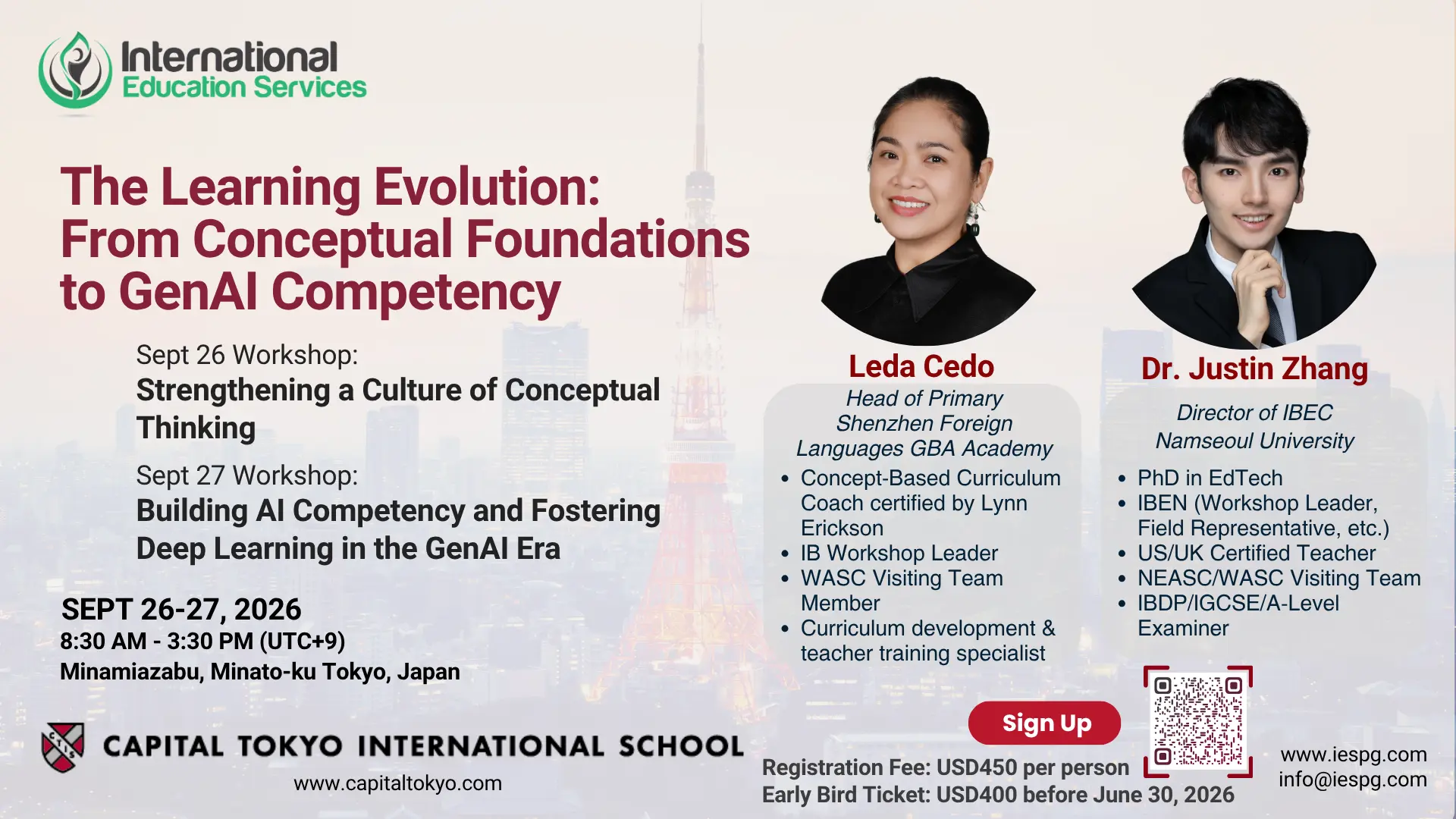
Join our two-day professional learning workshop for primary and secondary school educators. One session centers on deep, conceptual learning—how students build and transfer understanding through robust mental models. A follow-up session explores how Generative AI (GenAI) competencies magnify learning, with practical strategies for classroom design, assessment, and equity.
Goals: To strengthen teachers’ conceptual pedagogies, introduce AI literacies relevant to K–12, and provide ideas and strategies that integrate solid concept work with GenAI-enabled learning.
Audience: Primary and secondary school educators, Generalist and specialist teachers, and school leaders supporting instructional practice
Day 1 Workshop:Strengthening a Culture of Conceptual Thinking
The workshop aims to bridge theory and practice on concept-based inquiry, grounding participants in the foundational principles of essential and meaningful learning, while equipping them with immediately applicable strategies. Throughout the day, teachers will explore toolkits to help redesign units and transform how students engage with curriculum. Whether you teach primary or secondary, single subjects or interdisciplinary courses, this workshop will deepen your capacity to help students think conceptually and apply learning across contexts.
Day 2 Workshop: Building AI Competency and Fostering Deep Learning in the GenAI Era
As Generative AI rapidly transforms the educational landscape, our mandate as educators is twofold. First, we must build robust AI literacy and competency, both for ourselves and our students, moving beyond basic prompting to critical, ethical application. Second, we must safeguard and elevate the deeply human elements of learning. When AI can generate instant answers, how do we ensure our students continue to develop complex cognitive frameworks, practice metacognitive reflection, and navigate the emotional and ethical realities of this new era?
Join Dr. Justin Zhang for an interactive workshop designed to bridge the gap between technological competency and pedagogical excellence. The morning sessions are dedicated to building foundational AI literacy and designing classrooms that foster student AI competence. The afternoon sessions dive deep into the psychology of learning, providing practical frameworks to actively cultivate Cognitive, Metacognitive, and Affective skills in an AI-permeated world. Educators will leave with actionable strategies, redesigned assignments, and a renewed confidence in their pedagogical impact.
 |
 |
||
| Leda Cedo | Dr. Justin Zhang | ||
| Head of Primary, Shenzhen Foreign Languages GBA Academy | Director of IBEC, Namseoul University | ||
Bio:Leda Cedo is a highly experienced curriculum leader, having served learning communities in China, Korea, Japan, and the Philippines. Previously, she served as an Assistant Principal and Curriculum Coordinator, with a focus on IB framework and various curricular standards. Leda has collaborated with leadership and teaching teams to focus on data-driven evaluation of programmes, balanced literacy, transdisciplinary learning, conceptual- and inquiry-focused curriculum design, learning environment designs, and social-emotional learning. She is a Certified Presenter and Coach for Concept-Based Curriculum and Instruction and an IB Workshop Leader, and IB and WASC School Visitor. She has worked with numerous schools across Asia-Pacific. |
|
Bio: Justin Zhang, Ph.D., is a dedicated educator and educational leader specializing in educational technology and international education. Currently serving as Assistant Professor and Director of IBEC at Namseoul University, he brings extensive expertise from his previous role as Head of Chinese at an international school in Hong Kong. With a Ph.D. in Educational Technology (Cum Laude) and dual Master's degrees, Dr. Zhang is a registered teacher in both the US and UK who fulfills multiple roles within the International Baccalaureate Educator Network (Lead Education, Field Representative, Programme Leader, EvaluationLeader, Consultant, workshop leader, etc.) and examines for international curricula including IB, IGCSE, and A-levels. His international teaching experience spans Beijing and Barcelona, complemented by his contributions to educational advancement through accreditation committees and academic publications. |
|
Registration Fee:
(payable in USD)
26-27 Two days: USD450 per participant
Early bird Ticket for two days: USD 400 per participant before June 30, 2026
Paypal Payment: 6.8% fee applies
Certificate: E-certificate will be issued after the workshop.
Refund Policy:
• If the workshop is canceled for reasons beyond our control and we are unable to find a suitable alternative time for most participants, IES will inform participants of the cancellation and refund the actual paid registration fee only, additional expenses (such as hotel accommodations, transportation, etc.) are not eligible for refunds.
• If a registered participant notifies IES before 20/08/2026 that he or she cannot attend or transfer registration to another person or event, IES will issue a refund of the actual paid registration fee. However, if this notification is received after 20/08/2026, IES will not issue a refund.
• A 2% transaction fee, charged by the payment platform (not the organizer), will be deducted from any refunds.